It’s Thursday, and I debate whether or not to go to Skid Row. I can’t find my driver’s license and recall having it the last time I went, but haven’t seen it since. I spend a brief time looking for it while the chorus of Three Dog Night’s Joy to the World relentlessly rings in my head.
- Joy to the world
- All the boys and girls
- Joy to the fishes in the deep blue sea
- Joy to you and me.
I need to do laundry. I need to go food shopping. I need to get a good night’s sleep. There’s a good chance of rain and I think how much that’s going to suck. I shake my head. I committed to the commitment of once a week and choose to go. I go without my driver’s license.
- Joy to the world
- All the boys and girls
- Joy to the fishes in the deep blue sea
- Joy to you and me.
I arrive at Burger King and hitch a ride with a regular named Chris and two other women. We’re the first to arrive at our designated section on 6th just after Wall. We park behind a new white Mercedes SUV. Chris confirms it’s not part of our caravan as we get out and wait for the rest of the volunteers. The day was warm, and the stench hits me the moment I closed the car door. It’s bitter and musky and thick with layers of human excrement and decay. Subconsciously, I glance around the gutter for my license.
- Joy to the world
- All the boys and girls
- Joy to the fishes in the deep blue sea
- Joy to you and me.
Once again, the sidewalks are packed with bodies and tents, and we take to the street. The gutter is lined with Styrofoam containers and plastic bags. It’s an indication that another group was on The Row, handing out food. I look around. The night is quiet. The street is quiet. The residents are already full and probably stoned, which is why they’re quiet, too.
- Joy to the world
- All the boys and girls
- Joy to the fishes in the deep blue sea
- Joy to you and me.
We reach our spot and set up quickly. I take my preferred position at the curb to keep watch. It’s a fascination for me, and I fully get the draw Garry talked about during our interviews. Back in his day, Skid Row was a mob scene. Hundreds of people took to the streets, doing drugs out in the open, having sex out in the open, brawling in knockdown, dragged-out fights, to the death in some cases. That hasn’t been my experience in any of the dozens of times I’ve been to The Row, but I have heard stories. Not just with our group but others as well. I’m content with the low-grade action and drama of the real-life cautionary tales that play out on my nights.
It’s ham on white and PB&J for the giving, along with a bushel of persimmons. But the persimmons are firm and, like apples and other hard fruit, not really conducive to people with poor dental hygiene. In addition, the majority of the people in line don’t know what a persimmon is.
“It tastes a little like a melon but not as juicy, and you can eat the skin like an apple or pear,” I heard someone explain. Most of them pass on the offering.
Mel pulls me off the watch line and has me help greet people. The idea is to say hello and make small talk while they wait their turn, to humanize the experience. I get it, I agree with the interaction and do my best, giving compliments on a cool shirt or cute top. I ask how they’re doing, but that seems almost offensively naive. They’re on Skid Row, standing in line for free food because they’re homeless and/or too poor to afford food. Some people ignore me, while others give me a smile and say they’re fine. I feel like an asshole and I switch to talking about the weather and what a surprisingly warm night it is. After a few dozen people, the line starts to repeat. I remember some of their names and say hi again as they come back through the line.
A random woman comes through. She’s maybe in her 40s by the looks of it, but could be in her 20s for all I know. She’s haggard and seems a little rushed. She has a dove in a small birdcage, the size appropriate for a parakeet. The bottom grate is widely askew, and the bird sits at an angle. She’s holding the cage by a loop at the very top of it, and the body of it swings in reaction to her collecting her water and sandwich. The dove flutters its wings with alarm. There’s no water dish but a tray of what looks like sunflower seed shells.
It’s my second night back after taking a break from the despair, and I realize a bunch of the people who used to come through the line back when I volunteered regularly haven’t been by. There’s an older gentleman, maybe Armenian, who would say different celebrity musicians when it was his turn to collect a bottle of water and a sandwich. Jerry Lee Lewis was his staple alias, but he also used Elvis and Frank Sinatra. It cracked me up every time. He wasn’t what you would think of when you think about people living on The Row. He was short, a bit stout with glasses. He always wore these button-down, short-sleeved, lightweight dress shirts with pin stripes or rows of pale flowers, paired with a white undershirt, just like my Italian Grandfather used to wear. He looked like he belonged behind the counter of a dry cleaners or hardware store instead of on Skid Row. There are a few women who are MIA as well, and I pray they’re safe.
The line for food stops, and we have a ton of sandwiches left over. It seems ham on white bread is not a hot commodity on Skid Row tonight, and most of the people only come back for seconds, not thirds, fourths, or fifths like usual. Mel decides to take us on “the walk” again. Mel goes over the protocol about not allowing gaps within the group, not to stop, not to leave the group, and to keep moving until we’re told to stop. We load the table and other things into the back of the truck and take the water and about a hundred sandwiches around the block.
We walk past the Monday Night Mission shelter. By this time, the gate is locked with no one else in or out for the night. The courtyard is packed from wall to wrought iron gate with bodies. Somewhere from within, a radio blasts a vaguely familiar R&B song. As we round the corner onto San Pedro, the sidewalk is lined with tents. We take to the street, and I’m on the outside perimeter. People pop their heads out of their tents and out from behind tarps to ask for water or to see what kind of food we have. Sandwiches are handed out three at a time, and even then, it doesn’t make a dent in the amount we have.
As we walk, I see a volunteer drop a couple of water bottles. They roll a few feet. He bends over to pick them up, and another volunteer helps him. I cringe at the thought of the contaminants on the street that transferred to the bottle and now onto their hands. We’re specifically instructed not to pick up anything we drop on the ground, and for good reason. I watch him run his hand through his hair, and I ponder his consequences.
We turn onto 7th, something we were unable to do the week before because of the police barricade. It’s more of the same, the same tents, the same smell, the same rancid debris in the street and gutter. I spy quite a few new model cars parked at the curb and think, damn. There’s street art amongst the corrosion, and I’m distracted by the irony. Somewhere from behind the tarps and tents, I hear dogs barking.
“Kristine! Fill in the gap!” The street is quiet. Mel’s voice booms.
I’ve created a large gap between me and the person in front of me. I quicken my steps to catch up. I also still have a stack of sandwiches I haven’t handed out yet because I’m too busy looking around. We head down San Julian, and White Boy, who arrived to greet us shortly after we got to The Row, is now next to me. I say hi to him with a smile, and he reciprocates. As we walk, I get to know a little more about him. He’s vegan, from Alabama, lived on a farm, and mentioned how he and his brothers would have BBQ’s when they were younger. We talk about music, and he is partial to punk. I tell him I’m a mid-80s to mid-90s music kid. He tells me he’s a fan of ’80s music and starts listing some of his favorite hair bands like Poison, Ratt, and Def Leppard. I continue the list with Bon Jovi, Skid Row, Cinderella, and The Scorpions.
“The Scorpions! I loved that band,” he says with a big and perfect smile.
White Boy has been on Skid Row for 11 years and sober for the majority of it. I listen to what he’s willing to tell me and don’t ask questions. I tell him about Garry and his circumstances of how he came to live on Skid Row, stemming back to when he was raped at 11 years of age by an older boy in the neighborhood. Garry came to Skid Row in the mid-80s and got off it in 2001. He listens intently as I tell him the lessons Garry learned about healing from emotional trauma, about how talking about the abuse helped him deal with it, and how he learned to forgive himself and his attacker.
“It was a different time down here back then. I don’t think there are any OG’s from his day left,” White Boy says. “I’d think most of them are dead by now.”
I remember that being Garry’s sentiment as well. White Boy asks me what I do for a living, and I tell him I’m a writer. This piques his interest. It’s clear he has a story to tell, but he’s not sure if he wants to tell it.
“Kristine! Keep up!”
I created a gap again, lost in conversation with White Boy. I dash up to the person I’m supposed to be behind with all of my sandwiches. I see a person accessible to me, and I practically force him to take three sandwiches just so I can feel like I’m doing what I’m supposed to. We hit 6th, and we still have a whole box of sandwiches left, mostly ham on white. Mel decides to take us down the other side of San Julian.
“You’ll get to see where I live,” says White Boy to no one in particular.
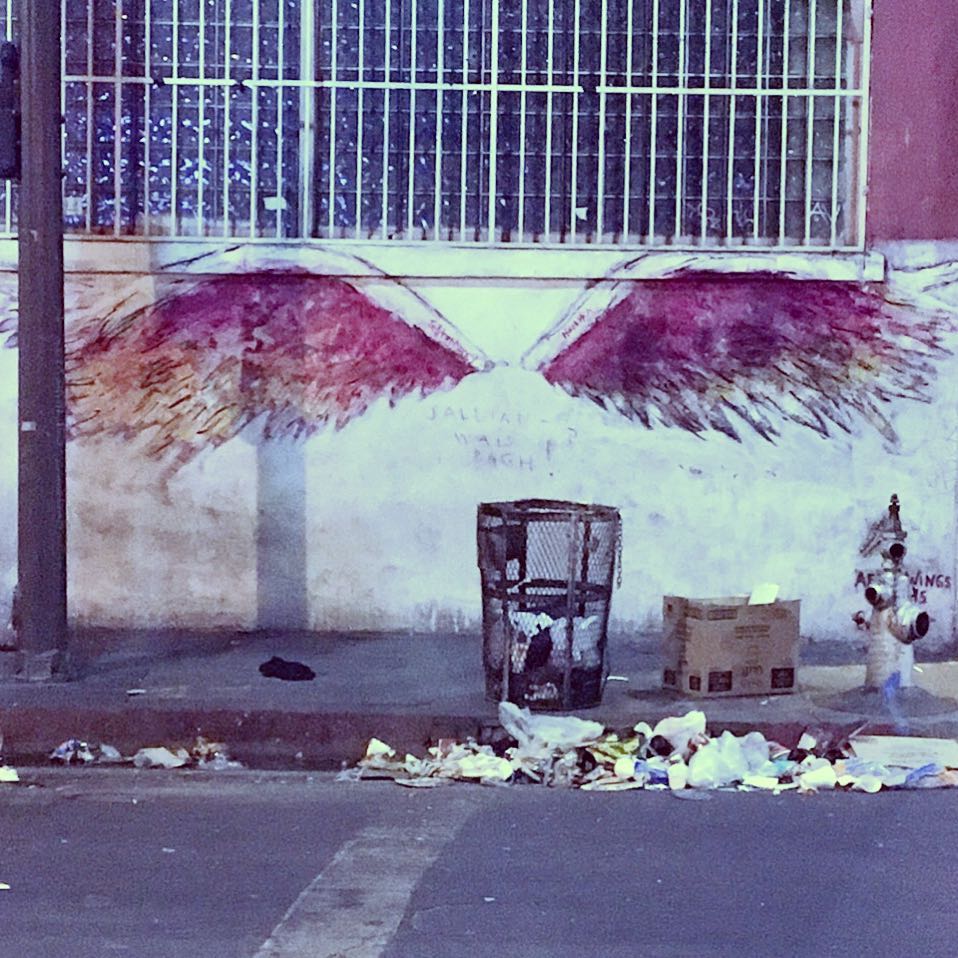
Mel has us hold up on the corner of 6th and San Julian, and I snap a few pictures. A pair of pink and blue angel wings is painted on a dirty white wall. The context of the wings, the backdrop, and the garbage in the gutter has me mesmerized. At our feet is a pile a debris ranging from human piss and shit to newspapers, napkins, paper plates, a random shoe and God knows what else. Cockroaches the size of my thumb create movement within the pile. In the distance, I see packs of rats take to the wall and scurry into gaps and crevasses.
“Kristine! I’m not gonna tell you again!”
The words are all too familiar as I realize I’m stationary on the exterior of the group as the rest cross the street. I’m once again startled into action. Mel shakes his head at me. White Boy announces we’ve approached his house. It’s a few tarps fashioned into a rectangular hut. He asks his neighbors if they want food or water. We head further down San Julian to 5th. I see two men on the sidewalk talking next to a tent. I ask if they want sandwiches, and they say yes. I dart over to them and hand off all that I have in my hands. It only took 8 seconds, and I was no more than 15 feet away from the group.
“Kristine! Don’t leave the group!”
I give him a ‘wtf’ look. “I handed them sandwiches, they’re right next to us.”
Mel softens his expression. “Don’t leave the group,” he says in a more caring/cautionary tone.
I get the message. It’s sometimes easy to forget Skid Row is dangerous. I realize I’ve lulled myself into a false sense of security. Nothing eventful ever happens on the nights I volunteer, and I’ve forgotten I’m not guaranteed safe passage because I have a sandwich in my hand. We are traditional society. We are intruders. We are the enemy. We are always outnumbered on The Row.
As we approach 5th, Mel has us wait. We’re standing in the center of the street. Few cars come through this part of town at night. I find myself looking into the face of a black and white pitbull. It’s tethered by a chain that disappears under the wall of a tent. It’s lean, very lean, borderline skinny. The dog is wagging its tail and whines for affection, a sandwich, or both. I want to give it food and water and love. Everything in me wants to take the dog with me, but all I can do is look into its eyes and feel my heartbreak.
“I get it,” White Boy says to me out of nowhere, as if he could sense my torment. “It gets lonely down here. People need to feel that love, but I would never do that to an animal. If you can’t do for you, how can you do for another living thing?”
I reach into the container with the remaining ham sandwiches and hand a stack of them to White Boy. “Do you know the dog’s owner? Maybe he’ll give some to the dog.” White Boy takes the sandwiches and heads over to the tent. Mel has us on the move again, back towards 6th. We reach the corner and cross against the light. We’re all headed back to our cars, and I’m lost in my head. I don’t remember what the car I arrived in looks like, and I find myself standing alone in the street, not knowing where to go. I trot up to a few cars, looking in the driver’s window for Chris. Some of them are not group volunteers. Suddenly I hear my name. One of the women from my carpool is waving me over to the SUV.
I get in and close the door. We set into motion, and like a switch, the earwig is back.
- Joy to the world
- All the boys and girls
- Joy to the fishes in the deep blue sea
- Joy to you and me.





 One Story at a Time